1. (1-4) Jesus travels from Judea to Galilee, passing though Samaria.
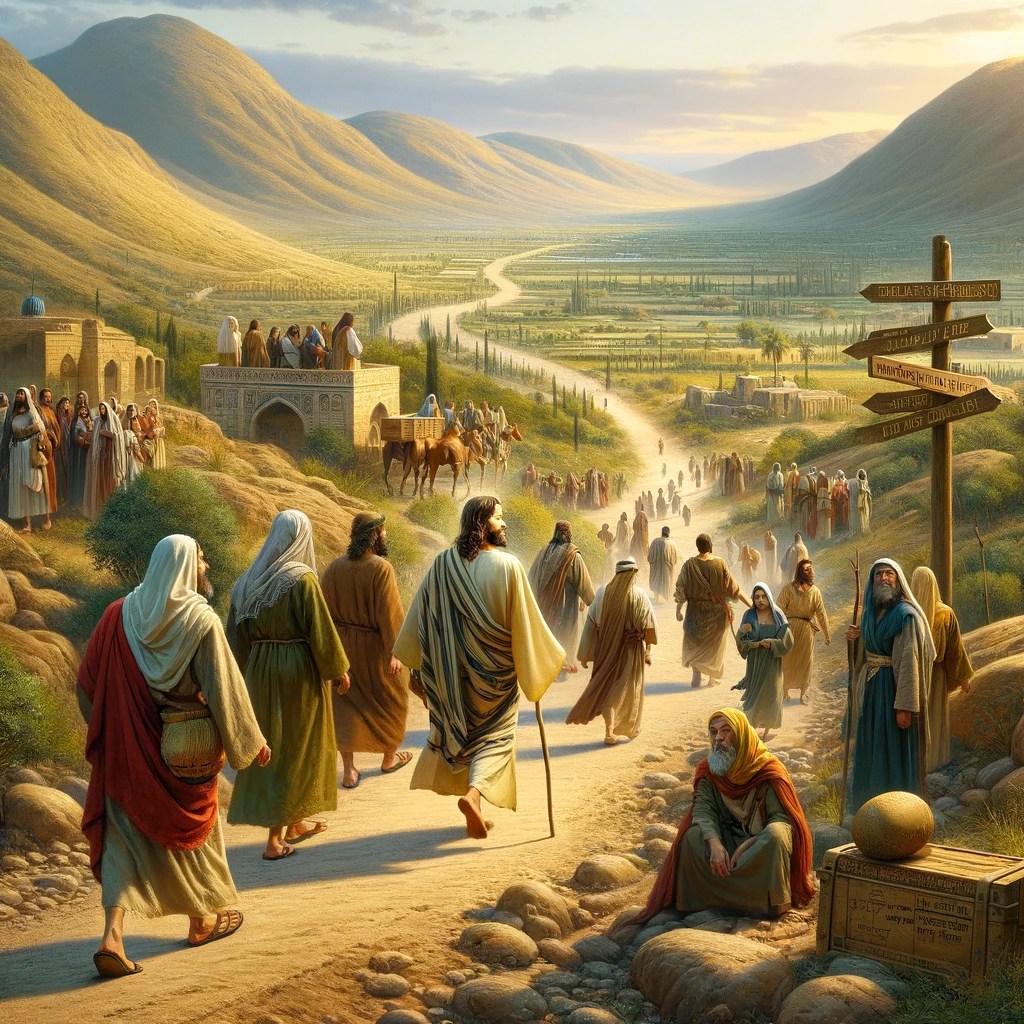
Therefore, when the Lord knew that the Pharisees had heard that Jesus made and baptized more disciples than John (though Jesus Himself did not baptize, but His disciples), He left Judea and departed again to Galilee. But He needed to go through Samaria.
a. When the Lord knew… He left Judea: Jesus knew that because of His rising prominence and popularity, there would soon be a confrontation with the religious establishment (among whom were the Pharisees). Yet, Jesus knew that the time was not yet right for a confrontation in Jerusalem, so He returned to Galilee.
b. Jesus made and baptized more disciples than John (though Jesus Himself did not baptize, but His disciples): Jesus’ work of baptism was first referred to in John 3:22. Jesus considered it important to also do John’s work of baptizing as a demonstration of repentance and cleansing in preparation for the Messiah. Here we learn that in the actual baptizing work, Jesus delegated that work to His disciples.
i. This also means that when the disciples began the practice of Christian baptism on Pentecost (Acts 2:41), their prior experience of baptizing was in connection with repentance, cleansing, and identification with the Messiah’s work.
ii. “By baptizing, He attested the unity of His work with that of the forerunner. By not Himself baptizing, he made the superiority of His position above that of John the Baptist to be felt.” (Godet, cited in Morris)
c. He needed to go through Samaria: Although the road through Samaria was the shortest route from Jerusalem to Galilee, pious Jews often avoided it. They did so because there was a deep distrust and dislike between many of the Jewish people and the Samaritans.
i. When the Assyrians conquered the northern kingdom of Israel (722 BC), they exiled almost all the Jewish population, removing them from the land. All they left behind were the lowest classes of society. 136 years later, the Babylonians conquered the southern kingdom of Judah and followed a similar policy. These ones left behind intermarried with other non-Jewish peoples who slowly came into the region, and the Samaritans emerged as an ethnic and religious group.
ii. Because the Samaritans had a historical connection to the people of Israel, their faith was a combination of commands and rituals from the Law of Moses, put together with various superstitions. Most of the Jews in Jesus’ time despised the Samaritans, disliking them even more than Gentiles – because they were, religiously speaking, “half-breeds” who had an eclectic, mongrel faith. The Samaritans built their own temple to Yahweh on Mount Gerizim, but the Jews burned it around 128 B.C. This obviously made relations between the Jews and the Samaritans even worse.
iii. “Their route from Jerusalem to Galilee lay through the region beyond the Jordan. This was considerably longer, but it avoided contact with the Samaritans. Those who were not so strict went through Samaria.” (Morris)
iv. It says that Jesus needed to go through Samaria. The need wasn’t because of travel arrangements or practical necessities, but because there were people there who needed to hear Him.
2. (5-6) Jesus comes to a well in Sychar of Samaria.

So He came to a city of Samaria which is called Sychar, near the plot of ground that Jacob gave to his son Joseph. Now Jacob’s well was there. Jesus therefore, being wearied from His journey, sat thus by the well. It was about the sixth hour.
a. Now Jacob’s well was there: The city of Sychar was ancient Shechem, and was the capital city of the Samaritans.
· This is where Abram first came when he arrived into Canaan from Babylonia. (Genesis 12:6)
· This is where God first appeared to Abram in Canaan, and renewed the promise of giving the land to him and his descendants. (Genesis 12:7)
· This is where Abram built an altar and called upon the name of the Lord. (Genesis 12:8)
· This is where Jacob came safely when he returned with his wives and children from his sojourn with Laban. (Genesis 33:18)
· This is where Jacob bought a piece of land from a Canaanite named Hamor, for 100 pieces of sliver. (Genesis 33:19)
· This is where Jacob built an altar to the Lord, and called it El Elohe Israel (Genesis 33:20). This established the connection between Jacob and what became known as Jacob’s well there in Sychar.
· Sychar (Shechem) was also the place where Dinah, the daughter of Jacob, was raped – and the sons of Jacob massacred the men of the city in retaliation. (Genesis 34)
· This was the plot of ground that Jacob gave his son Joseph, land Jacob had conquered from the Amorites with his sword and bow in an unrecorded battle. (Genesis 48:22)
· This is where the bones of Joseph were eventually buried when they were carried up from Egypt. (Joshua 24:32)
· This is where Joshua made a covenant with Israel, renewing their commitment to the God of Israel and proclaiming, as for me and my house, we will serve the Lord. (Joshua 24)
i. “Some think that Sychar, which means ‘drunken,’ was originally a contemptuous name applied by the Jews to Shechem.” (Alford)
b. Being wearied from His journey: After a long day walking, Jesus was wearied. John has been careful to show us that Jesus is God, but also wanted us to know that Jesus was not a super-man. Jesus genuinely submitted to our human limitations.
i. Sat thus by the well: “That little word thus seems to have a force difficult to reproduce in English. It is apparently intended to enhance the idea of utter weariness.” (Maclaren)
ii. “While our Evangelist insists that it was the divine Word that became flesh in Jesus, he insists at the same time that what the divine word became was flesh.” (Bruce)
iii. “This ‘spring’ of Jacob is beyond doubt that known to-day by Samaritan, Jew, Christian, and Moslem as the ‘spring’ or ‘well’, ‘of Jacob.’” (Trench)
c. It was about the sixth hour: By the reckoning John used, this was about noon, during the heat of the day. Jesus, being tired and hot, would have wanted a refreshing drink.
Question 1: Why did Jesus “have to go through Samaria”?
3. (7-9) Jesus speaks with a Samaritan woman.

A woman of Samaria came to draw water. Jesus said to her, “Give Me a drink.” For His disciples had gone away into the city to buy food. Then the woman of Samaria said to Him, “How is it that You, being a Jew, ask a drink from me, a Samaritan woman?” For Jews have no dealings with Samaritans.
a. A woman of Samaria came to draw water: This woman came for water at an unusual hour and she came alone. Typically, women came for water earlier in the day and they came in groups. Perhaps there was a sudden need, or perhaps she was a social outcast, shunned by other women in the community.
i. “Women usually came to draw water in company, and at a cooler time of the day.” (Bruce)
ii. Adam Clarke extended this thought: “The Jews say that those who wished to get wives went to the wells where young women were accustomed to come and draw water; and it supposed that women of ill fame frequented such places also.”
iii. All in all, this woman is a fascinating character. “She is of mature age, and has had a not altogether reputable past. She is frivolous, ready to talk with strangers, with a tongue quick to turn grave things into jests; and yet she possesses, hidden beneath masses of unclean vanities, a conscience and a yearning for something better than she has.” (Maclaren)
iv. The disciples had gone away into the city, perhaps passing her on their way into town. “We can be certain at this stage of their lives Peter and the others would never have moved off the path for any woman, much less a Samaritan and perhaps one with loose morals at that. Perhaps she had been pushed aside or made to wait while the body of Galileans marched by.” (Boice)
b. Jesus said to her: By tradition, a rabbi would not speak with a woman in public, not even with his own wife. It was also very unusual for a Jewish person of that time to ask a favor or accept a drink from a Samaritan’s cup. Jesus’ request genuinely surprised the woman. The disciples were also surprised that Jesus spoke to her (John 4:27).
i. “The strict Rabbis forbade a Rabbi to greet a woman in public. A Rabbi might not even speak to his own wife or daughter or sister in public. There were even Pharisees who were called ‘the bruised and bleeding Pharisees’ because they shut their eyes when they saw a woman on the street and so walked into walls and houses!” (Barclay)
c. Give Me a drink: Some people imagine that God is most glorified when human participation is most excluded. Yet Jesus did not diminish His glory one bit by asking the help and cooperation of the Samaritan woman. As it worked toward the accomplishment of the divine purpose, the Father and the Son were most glorified in this display of love and goodness to the woman.
i. Give Me a drink: “He is not unaware that the way to gain a soul is often to ask a service of it.” (Godet, cited in Morris)
ii. In all this, we see many of the seeming paradoxes of Jesus’ work.
· He who gives rest is weary.
· He who is Israel’s Messiah speaks to a Samaritan woman.
· He who has living water asks for a drink from a well.
iii. “He felt that his miraculous power was to be used for others, and in his great work; but as for himself, his humanity must bear its own infirmity, it must support its own trials: so he keeps his hand back from relieving his own necessities.” (Spurgeon)
iv. There is every reason to believe that she gave Jesus what He asked for, and she asked the question of John 4:9 as Jesus drank the water, or after Jesus drank the water from the well.
d. How is it that You, being a Jew, ask a drink from me, a Samaritan woman? Immediately, the woman was impressed by the friendliness of Jesus. It was unusual for her to hear a kind greeting from a Jewish man, for generally speaking, Jews have no dealings with Samaritans.
i. John felt this was so well understood in his day that he needed no further explanation. “The deadly hatred that subsisted between these two nations is known to all. The Jews cursed them, and believed them to be accursed. Their most merciful wish to the Samaritans was, that they might have no part in the resurrection; or, in other words, that they might be annihilated.” (Clarke)
ii. For many reasons, this woman would have been despised by most of the religious leaders in the days of Jesus. She was a woman, a Samaritan, and a woman of questionable reputation. Yet, in the interview with Nicodemus John showed us, Jesus has something to say to the religious establishment. In the meeting with the Samaritan woman at the well John showed us, Jesus has something to say to those despised by the religious establishment.
Question 2: Why did Jesus choose to engage her in conversation?
Question 3: There were plenty of legitimate reasons for Jesus to avoid the Samaritan woman. In what ways has Jesus gone out of His way to affect your life?
4. (10-12) Jesus interests the woman in living water.

Jesus answered and said to her, “If you knew the gift of God, and who it is who says to you, ‘Give Me a drink,’ you would have asked Him, and He would have given you living water.” The woman said to Him, “Sir, You have nothing to draw with, and the well is deep. Where then do You get that living water? Are You greater than our father Jacob, who gave us the well, and drank from it himself, as well as his sons and his livestock?”
a. If you knew the gift of God, and who it is who says to you, “Give Me a drink”: Jesus drew the woman into conversation, making her curious about several things.
· He made her curious about the things of God (If you knew the gift of God).
· He made her curious about who Jesus is (who it is who says to you).
· He made her curious about what He could give her (He would have given you living water).
i. There is a principle connected with the words if you knew… you would have asked Him: If you knew more, you would pray more.
ii. There is another principle at work: Jesus often speaks to us as if we were more spiritual or understanding than we actually are. He does this on purpose.
b. He would have given you living water: In ancient times they called spring water living water because it seemed alive as it bubbled up from the ground. At first glance, it might seem that Jesus told this woman about a nearby active spring. But Jesus made a play on words with the phrase “living water,” because He meant the spiritual water that quenches spiritual thirst and gives life.
i. “In the Old Testament living water is sometimes associated with Jehovah. He is called ‘the fountain of living waters’ (Jeremiah 2:13, 17:13).” (Morris)
ii. “The (admittedly much later) Samaritan liturgy for the Day of Atonement says of the Taheb (the Samaritan counterpart to the Jewish Messiah), ‘Water shall flow from his buckets’ (language borrowed from Balaam’s oracle in Numbers 24:7).” (Bruce)
c. You have nothing to draw with: Going into town, the disciples probably took with them the leather pouch used as a bucket to draw water.
d. Are you greater than our father Jacob: It is hard to tell if the woman asked a sincere question, or if she was a cynical critic. All depended on the tone of her voice. The fact that she came to belief at the end of her encounter with Jesus may suggest it was an honest question.
5. (13-15) Jesus describes the effect of the living water He offers.

Jesus answered and said to her, “Whoever drinks of this water will thirst again, but whoever drinks of the water that I shall give him will never thirst. But the water that I shall give him will become in him a fountain of water springing up into everlasting life.” The woman said to Him, “Sir, give me this water, that I may not thirst, nor come here to draw.”
a. Whoever drinks of this water will thirst again: Jesus knew that this woman – and everyone in the village – had to come to this well daily to satisfy their natural thirst. Jesus used thirst as a picture of the spiritual need and longing that everyone has.
b. Whoever drinks of the water that I shall give him will never thirst: Jesus made an amazing offer. What he offered – to this woman and to anyone who would drink – was something to give lasting satisfaction. The key is to drink of the water that Jesus shall give.
i. It’s common for people to try and satisfy their God-created inner thirst through many things, or through any thing except for what Jesus gives. People are thirsty – they want, they long, they search, they reach; but only what Jesus gives satisfies to the deepest levels of man’s soul and spirit.
ii. Drinking and thirst are common pictures of God’s supply and man’s spiritual need. Drinking is an action, but an action of receiving – like faith, it is doing something, but it is not a merit-earning work in itself.
iii. “What does a thirsty man do to get rid of his thirst? He drinks. Perhaps there is no better representation of faith in all the Word of God than that. To drink is to receive-to take in the refreshing draught-and that is all. A man’s face may be unwashed, but yet he can drink; he may be a very unworthy character, but yet a draught of water will remove his thirst. Drinking is such a remarkably easy thing, it is even more simple than eating.” (Spurgeon, Good News for Thirsty Souls)
iv. Someone might object: “I drank of what Jesus offers, and I feel thirsty and empty again.” The answer is simple: drink again! It isn’t a one-time sip of Jesus that satisfies forever, but continual connection with Him.
c. But the water that I shall give him will become in him a fountain of water springing up into everlasting life: The effect of this water does much more than simply satisfy the thirst of the one who drinks it. It also creates something good, something life-giving in the heart of the one who drinks it. It becomes a fountain of water springing up into everlasting life.
d. Sir, give me this water: The response of the Samaritan woman was logical, yet not spiritual. She wanted to avoid the work of coming to the well every day. It was as if she responded, “Jesus, if you want to make my life easier and more convenient, then I’m all for it. Give it to me!”
Question 4: How does Jesus’ offer of “living water” challenge our understanding of spiritual fulfillment compared to temporary satisfactions?
6. (16-19) Jesus speaks of her sinful life.

Jesus said to her, “Go, call your husband, and come here.” The woman answered and said, “I have no husband.” Jesus said to her, “You have well said, ‘I have no husband,’ for you have had five husbands, and the one whom you now have is not your husband; in that you spoke truly.” The woman said to Him, “Sir, I perceive that You are a prophet.”
a. Go, call your husband, and come here: This was not a strange request. In this extended, public conversation with the woman, Jesus was straining the boundaries of cultural propriety. The conversation would be more culturally appropriate if the woman’s husband were present.
b. I have no husband…you have had five husbands: The woman claimed to have no husband – which was technically true, but Jesus knew – supernaturally – that there was much more to the story of the woman’s marriage history.
i. “Christ has different doors for entering into different people’s souls. Into some, he enters by the understanding; into many, by the affections. To some, he comes by the way of fear; to another, by that of hope; and to this woman he came by way of her conscience.” (Spurgeon)
c. And the one whom you now have is not your husband: Jesus brought up this embarrassing issue because her sinful life had to be confronted. This woman had to decide what she loved more: her sin or the Messiah.
i. When Jesus said that the man she lived with was “not your husband,” Jesus showed that living together and marriage are not the same thing. Jesus also showed that just because someone calls a relationship marriage, it does not mean that Jesus considers it marriage.
ii. “I am persuaded that the right account is found, in viewing this command, as the first step of granting her request, ‘give me this water.’ The first work of the Spirit of God, and of Him who here spoke in the fullness of that Spirit, is, to convince of sin.” (Alford)
d. Sir, I perceive that You are a prophet: This was an obvious observation from the woman. She was no doubt surprised; perhaps stunned that Jesus had supernatural knowledge of her life.
i. “It would have been better if she had perceived that she was a sinner.” (Spurgeon)
Question 5: When Jesus told the woman to get her husband, He revealed that His knowledge of her wasn’t limited by her self-disclosure. What does this reality tell you about God’s knowledge of the details of your life?
7. (20-26) The Samaritan woman and Jesus discuss worship.

“Our fathers worshiped on this mountain, and you Jews say that in Jerusalem is the place where one ought to worship.” Jesus said to her, “Woman, believe Me, the hour is coming when you will neither on this mountain, nor in Jerusalem, worship the Father. You worship what you do not know; we know what we worship, for salvation is of the Jews. But the hour is coming, and now is, when the true worshipers will worship the Father in spirit and truth; for the Father is seeking such to worship Him. God is Spirit, and those who worship Him must worship in spirit and truth.” The woman said to Him, “I know that Messiah is coming” (who is called Christ). “When He comes, He will tell us all things.” Jesus said to her, “I who speak to you am He.”
a. Our fathers worshipped on this mountain: It is possible that this was a genuine source of confusion and a stumbling block to her, but it is more likely that this simply was an evasion, trying to avoid the issue of her many prior husbands and her current non-husband.
i. If she offered an argument about places of worship here, Jesus didn’t take the bait. Jesus was more interested in winning a soul than in winning an argument.
b. You worship what you do not know: The Samaritans believed that Moses commissioned an altar on Mount Gerazim, the mountain of blessing – this was their justification of their system of worship on that mountain. But like all faith that tries to combine elements of different religions, they worship what they do not know.
i. You worship what you do not know; we know what we worship: “Both his ‘ye’ and His ‘we’ are emphatic. He sets Jews and Samaritans in sharp contrast. And He associates Himself quite definitely with the Jews.” (Morris)
ii. The Samaritans also only accepted the first five books of the Hebrew Scripture, and rejected the rest. “The Samaritans took as much of scripture as they wished and paid no attention to the rest.” (Barclay)
c. The hour is coming when you will neither on this mountain, nor in Jerusalem, worship the Father: Jesus pointed her to a time when worship would no longer be focused on places (neither Jerusalem nor Mount Gerazim). The greater work of Jesus would bring a greater, more spiritual worship.
i. Dods said of this promise, “One of the greatest announcements ever made by our Lord; and made to one sinful woman.”
ii. “The prophetic ye shall worship, though embracing in its wider sense all mankind, may be taken primarily as foretelling the success of the Gospel in Samaria, Acts 8:1-26.” (Alford)
d. God is Spirit, and those who worship Him must worship in spirit and truth: With these words Jesus described the basis for true worship: it is not found in places and trappings, but in spirit and in truth.
i. To worship in spirit means you are concerned with spiritual realities, not so much with places or outward sacrifices, cleansings, and trappings.
ii. To worship in truth means you worship according to the whole counsel of God’s word, especially in light of the New Testament revelation. It also means that you come to God in truth, not in pretense or a mere display of spirituality.
e. I who speak to you am He: Though this woman was a sinner, Jesus revealed Himself to her. Jesus reveals Himself to sinners.
Question 6: Why did Jesus choose to reveal His identity as the Messiah at this time and place? Why did Jesus choose to reveal Himself to you?
Question 7: The Samaritan Woman was surprised that Jesus spoke to her. Whom might be surprised by you initing a conversation regarding spiritual matters?
8. (27-30) The woman tells her neighbors.

And at this point His disciples came, and they marveled that He talked with a woman; yet no one said, “What do You seek?” or, “Why are You talking with her?” The woman then left her waterpot, went her way into the city, and said to the men, “Come, see a Man who told me all things that I ever did. Could this be the Christ?” Then they went out of the city and came to Him.
a. The disciples came, and they marveled that He talked with a woman: The disciples were surprised that Jesus stretched the limits of cultural propriety with the extended conversation with the Samaritan woman. Yet – probably sensing that it was right and appropriate – they did not question Jesus about this.
i. Yet no one said: “Their silence was due to reverence. They had already learned that He had reasons for His actions which might not lie on the surface.” (Dods) “They had learned enough to know that, while Jesus did not always respect the conventions of the Rabbis, He had good reasons for what He did.” (Morris)
b. The woman then left her waterpot, went her way into the city: Perhaps sensing the silent awkwardness of the disciples, the woman left her conversation with Jesus and went back into the city of Sychar. She left so impressed by her time with Jesus (and so certain she would return to him) that she left her waterpot at the well.
i. The left-behind waterpot is the kind of small point remembered by an eyewitness. As one of the disciples to see this, John remembered this event clearly.
c. Come, see a Man who told me all the things that I ever did. Could this be the Christ? Jesus so impressed this woman that she was compelled to tell those in her city that they should come to the well and meet Jesus. Jesus impressed and attracted her, even though He confronted her with her sin (all the things that I ever did).
i. The Samaritan woman was so impressed by the love of Jesus that she now sought out her fellow villagers, even when they had treated her as an outcast before. “If she had avoided the company of her fellow-citizens before, she was a changed woman now; she must seek them out and share her news with them.” (Bruce)
ii. The Samaritan woman was so impressed by the love of Jesus – even as He confronted her sin – that she forgot that she would rather everyone else forget all the things that I ever did. “This pardonable exaggeration indicates the profound impression that Jesus’ knowledge of her private life had made on her.” (Morris)
iii. Jesus displayed so much love and such a sense of security that she felt safe with Him even when her sin was exposed. It’s important for the followers of Jesus to give people today a safe place to confess their sin, repent, and put their trust in Jesus.
iv. The whole interaction with Jesus did not leave her with the impression, “He hates me” or “He judges me” or “He doesn’t want me around.” It left her with the impression that quite possibly, Jesus was who He claimed to be: the Messiah, the Christ (I who speak to you am He, John 4:26).
v. Told me all things that I ever did: “The Jews believed that one essential characteristic of the Messiah would be, that he should be able to tell the secrets of all hearts. This they believed was predicted, Isaiah 11:2, 3.” (Clarke) It isn’t unreasonable to think that some among the Samaritans believed similar things about the Messiah.
d. Then they went out of the city and came to Him: The woman’s invitation was effective. The people came when she told them who Jesus was and how He had impacted her life with their brief conversation.
Question 8: After her conversation with Jesus, the woman was dramatically transformed. In what ways has your life been changed by your relationship with Jesus?
9. (31-34) Jesus teaches His disciples the source of His strength and satisfaction.

In the meantime His disciples urged Him, saying, “Rabbi, eat.” But He said to them, “I have food to eat of which you do not know.” Therefore the disciples said to one another, “Has anyone brought Him anything to eat?” Jesus said to them, “My food is to do the will of Him who sent Me, and to finish His work.”
a. I have food to eat of which you do not know: The disciples went into the Samaritan village to get food, and wanted Jesus to eat what they brought to Him.
i. “It is right for the spiritual man to forget his hunger, but it is equally right for his true friends to remind him that he ought to eat for his health’s sake: it is commendable for the worker to forget his weakness and press forward in holy service; but it is proper for the humane and thoughtful to interpose with a word of caution, and to remind the ardent spirit that his frame is but dust. I think the disciples did well to say, ‘Master, eat.’” (Spurgeon)
ii. Jesus wasn’t saying that food and drink and rest are not important. Instead, He wanted His disciples to know that life was more than those things; that man does not eat by bread alone.
iii. I have food to eat of which you do not know: “The pronouns are emphatic: I am refreshed by nourishment hidden from you.” (Dods)
iv. “In these words our Lord revealed the secret of His strength, and that of the weakness of His disciples.” (Morgan)
b. My food is to do the will of Him who sent Me: Jesus had a greater source of strength and satisfaction than the food He ate. Jesus explained to His disciples that His true satisfaction was to do the will of His God and Father.
i. Jesus did not have His focus primarily on the work, the need, the strategy, the techniques, or even the needy soul. First and foremost His focus was on doing the will of Him who sent Me. In contrast, Satan is the ultimate example of one who did not want the will of God, but asserted his will against God’s will (Isaiah 14:12-15).
ii. “He does not even say, ‘My meat is to do my Father’s will.’ He takes a lower position than that of sonship, and dwells chiefly upon his mission, its service, and the absorption in the will of God which it involved.” (Spurgeon)
iii. The experience of countless others through the centuries has proved Jesus true in this statement. There is nothing more satisfying than doing the work of God, whatever that is for the particular believer. Though this is counter-intuitive and against our natural self-seeking, it is true.
iv. “The man of the world thinks that, if he could have his own way, he would be perfectly happy, and his dream of happiness in this state or in the next is comprised in this, that his own wishes will be gratified, his own longings fulfilled, his own desires granted to him. This is all a mistake. A man will never be happy in this way.” (Spurgeon)
v. Jesus found great satisfaction in doing the will of God even when He was weary. In fact, the conscious doing of God’s will refreshed the weary Jesus. “The bodily thirst (and hunger probably, from the time of day) which our Lord had felt before, had been and was forgotten in the carrying on of His divine work in the soul of this Samaritan woman.” (Alford)
c. And to finish His work: Jesus found satisfaction in not merely starting the work of God, but finishing it. This completes the thought begun in the previous verse.
· Jesus was surrendered to the Master’s will.
· Jesus was on a recognized commission.
· Jesus came to do.
· Jesus came to finish His work.
i. To finish His work: “The verb is cognate with that used on the cross, when Jesus cried ‘It is finished’ (John 19:30).” (Morris)
10. (35-38) Jesus teaches His disciples about the urgency of spiritual work and opportunity.

Do you not say, ‘There are still four months and then comes the harvest’? Behold, I say to you, lift up your eyes and look at the fields, for they are already white for harvest! And he who reaps receives wages, and gathers fruit for eternal life, that both he who sows and he who reaps may rejoice together. For in this the saying is true: ‘One sows and another reaps.’ I sent you to reap that for which you have not labored; others have labored, and you have entered into their labors.”
a. There are still four months and then comes the harvest: This was a proverb with the idea that there is no particular hurry for a task because things simply take time and you can’t avoid the waiting. Jesus did not want His disciples to have this mentality; He wanted them to think and act as if the harvest was ready now.
i. “In Greek the words ‘Yet four months and harvest comes’ have a rhythmic form which suggests that we have to do with a popular or proverbial saying.” (Bruce)
ii. “The harvest is ready. The wages are there. Let no man hang back. A harvest will not wait.” (Morris)
b. Lift up your eyes and look at the fields, for they are already white for harvest! Jesus used the idea of food and harvest to communicate spiritual ideas. The idea of harvest meant that there were many people ready to be received into the Kingdom of God, and that the disciples should see themselves as workers – reapers – in that harvest.
i. “As he was speaking, the Samaritans were leaving the town and coming across the fields toward him. The eagerness of the people the Jews regarded as alien and rejected showed that they were like grain ready for harvesting.” (Tenney)
ii. Jesus warned His disciples to not think, there are still four months and then comes the harvest. If they had the eyes to see it, the harvest was ready now – even white for harvest, implying that the grain was fully ripe or over ripe.
iii. We should believe, they are already white for harvest!“Expect a present blessing; believe that you will have it; go to work to get it, and do not be satisfied unless you do have it.” (Spurgeon)
c. He who reaps receives wages, and gathers fruit for eternal life, that both he who sows and he who reaps may rejoice together: Jesus encouraged His disciples in their work with Him in at least three ways.
· Their work in the harvest would be rewarded (He who reaps receives wages).
· The good of their work would last forever (gathers fruit for eternal life).
· Every worker in the harvest would rejoice together in the work.
d. I sent you to reap that for which you have not labored; others have labored, and you have entered into their labors: The disciples could now reap a harvest immediately, and they reaped it from seeds they didn’t sow.
i. John the Baptist and Jesus sowed the seeds, and at the moment the disciples had the opportunity to reap. Many times, this is how the work of God happens – one sows and another reaps (1 Corinthians 3:6-8).
Question 9: How can I better recognize the opportunities in my own life to contribute to the spiritual harvest, and what steps can I take to engage more actively in this urgent work?
11. (39-42) Many Samaritans believe in the Savior of the world.

And many of the Samaritans of that city believed in Him because of the word of the woman who testified, “He told me all that I ever did.” So when the Samaritans had come to Him, they urged Him to stay with them; and He stayed there two days. And many more believed because of His own word. Then they said to the woman, “Now we believe, not because of what you said, for we ourselves have heard Him and we know that this is indeed the Christ, the Savior of the world.”
a. Many of the Samaritans of that city believed in Him: At that moment they did not know enough to trust Jesus and His work on the cross; but they could most certainly believe in Him as the Messiah of God. They did believe, and because of the word of the woman who testified.
b. He told me all that I ever did: The woman was amazed not only that Jesus knew the facts of her life, but that He loved her even knowing the facts of her life. We sometimes fear that if someone knew all that I ever did, they could not love us, but Jesus loved this woman.
c. He stayed there two days: This was remarkable in light of the opinions of most of the Jewish people of Jesus’ day regarding the Samaritans. They regarded Samaria and the Samaritans as a place and people to avoid if possible, and if it were necessary to go through Samaria it should be done as quickly as possible. Yet Jesus stayed there two days.
i. “That Samaritans should invite a Jewish teacher to stay with them, with no fear of a rebuff, shows how completely he had won their confidence.” (Bruce)
ii. “During the stay His reasoning and discoursing added greatly to the number of the believers and supplemented the woman’s work.” (Trench)
d. Many more believed because of His own word: In the days Jesus spent among the Samaritans He taught them, and many more believed.
i. “We may wonder if this was the same ‘city of Samaria’ as was evangelized by Philip a few years later [Acts 8:5].” (Bruce)
e. We know that this is indeed the Christ, the Savior of the world: The remarkable testimony of the woman at the well connected these Samaritans of Sychar to Jesus; but in hearing Him they came to a deeper personal faith in Jesus as both Messiah (Christ) and the Savior of the world.
i. Savior of the world: “Not of the Jews only, but of the Samaritans, and of the whole Gentile world.” (Clarke)
ii. “The title ‘Saviour of the World’ was of course prompted by the teaching of Jesus Himself during His two days’ residence.” (Dods)
Question 10: The people in the town first believed because they saw the change in the woman. Later, their faith was strengthened as they met Jesus. Is your faith based on your personal encounter with Jesus or on your encounter with people who know him? What is the difference?
Question 11: What life principles did you learn from the study of the Samaritan woman’s life? How will you apply these principles in your life?
Reference List:
- Enduring Word Bible Commentary – John 4 https://enduringword.com/bible-commentary/john-4/
- Twelve Extraordinary Women, How God Shaped Women of the Bible and What He Wants to Do With You, John MacArthur. https://amzn.to/3IJ1j2b
Radiant Ministries International
"Remaking Lives Through Christ"

Your message has been sent

 Radiant Ministries International
Leave a comment